
The Growth of Christianity
Series: Acts: Church on the Move
Summary
Acts: Church on the Move
Text: Acts 11:19–12:5
Theme: The Growth of Christianity
Introduction: A God-Given Drive to Grow
From city-building games to business ventures, from historic explorers to space travel, humanity has always been driven to expand, build, and explore. This impulse reflects the imago Dei—the image of God—who created, spoke, and commissioned humanity to fill the earth and exercise dominion (Genesis 1:28).
Though sin fractured the world, Jesus came to redeem it and commissioned His people to build His kingdom. That restlessness for “more” may be God-given fuel for mission.
In Acts, the early church understood their identity as a sent people, echoing Jesus’ words:
-
“As the Father has sent me, even so I am sending you”
-
“Go and make disciples of all nations”
-
“You will be my witnesses…to the ends of the earth”
Premise: Growth and Opposition Go Hand in Hand
Acts 11:19-12:5
19 Now those who were scattered because of the persecution that arose over Stephen traveled as far as Phoenicia and Cyprus and Antioch, speaking the word to no one except Jews. 20 But there were some of them, men of Cyprus and Cyrene, who on coming to Antioch spoke to the Hellenists also, preaching the Lord Jesus. 21 And the hand of the Lord was with them, and a great number who believed turned to the Lord. 22 The report of this came to the ears of the church in Jerusalem, and they sent Barnabas to Antioch. 23 When he came and saw the grace of God, he was glad, and he exhorted them all to remain faithful to the Lord with steadfast purpose, 24 for he was a good man, full of the Holy Spirit and of faith. And a great many people were added to the Lord. 25 So Barnabas went to Tarsus to look for Saul, 26 and when he had found him, he brought him to Antioch. For a whole year they met with the church and taught a great many people. And in Antioch the disciples were first called Christians. 27 Now in these days prophets came down from Jerusalem to Antioch. 28 And one of them named Agabus stood up and foretold by the Spirit that there would be a great famine over all the world (this took place in the days of Claudius). 29 So the disciples determined, every one according to his ability, to send relief to the brothers living in Judea. 30 And they did so, sending it to the elders by the hand of Barnabas and Saul.
12:1 About that time Herod the king laid violent hands on some who belonged to the church. 2 He killed James the brother of John with the sword, 3 and when he saw that it pleased the Jews, he proceeded to arrest Peter also. This was during the days of Unleavened Bread. 4 And when he had seized him, he put him in prison, delivering him over to four squads of soldiers to guard him, intending after the Passover to bring him out to the people. 5 So Peter was kept in prison, but earnest prayer for him was made to God by the church.
Picture: The Spread of the Gospel
Jerusalem → Judea → Samaria → Joppa/Caesarea → Phoenicia & Cyprus → Antioch
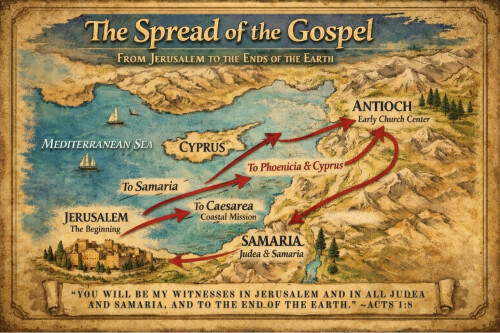
God’s will is not stagnation but growth.
-
Acts 2:47 — The Lord added daily those being saved
-
Ephesians 4:16 — The body grows as each part works properly
-
Matthew 28:19–20 — The Great Commission
-
Matthew 16:18 — Christ builds His church
There are seasons (2 Timothy 4:2), but Christ is always building His church. The church must think offensively—about taking ground.
This Growth Really Happened
Acts records real people, real places, and real events.
-
King Herod
-
Emperor Claudius
-
A documented famine
Christianity grew from a small band of disciples into a global movement—over 2.5 billion today.
Historical and archaeological evidence consistently affirms Acts:
-
Verified cities, synagogues, and Roman presence
-
Confirmed political titles and landmarks
-
Accurate maritime routes
NT scholars affirm Acts’ historicity (Colin Hemer; F. F. Bruce).
View More Examples of the Historicity in Acts
Conclusion: Scripture is inspired and reliable (2 Peter 1:20–21).
Acts 17:6 captures the impact:
“These men who have turned the world upside down have come here also.”
God Brings the Growth
-
Acts 11:21 — “The hand of the Lord was with them”
-
Growth flows from preaching Christ
-
Acts 11:23–24 — Grace observed, faith encouraged, people added
Growth is God’s work of grace.
-
1 Corinthians 3:6–7 — God gives the growth
Healthy growth flows from:
Prayer → Word → Holy Spirit → God’s Grace
When growth happens, God gets the glory.
Growth Takes Time and Proximity
God plays the long game.
-
Acts 11:25–26 — Barnabas and Saul taught for a full year in Antioch
-
Jesus discipled for 3.5 years
-
Paul invested years in key cities
Fast growth is rarely deep growth.
Healthy growth requires patience, presence, and consistency.
Growth Leads to Multiplication
Antioch became a missionary sending hub.
-
Acts 11:27–30 — Generosity toward the Jerusalem church
-
Antioch sent Paul and Barnabas on multiple missionary journeys
Gospel growth produces:
-
Generosity
-
Sacrifice
-
A kingdom mindset
Multiplication requires giving ourselves away.
Growth Brings Opposition
Persecution scattered believers—and spread the gospel (Acts 11:19–20).
Opposition often becomes the means of expansion.
-
Acts 12:1–5 — James is killed, Peter imprisoned
-
The church responds with earnest prayer
Jesus promised:
-
Matthew 16:18 — The gates of hell will not prevail
Conclusion: Let’s Grow Together
The early church depended on God, embraced multiplication, invested relationally, and persevered through opposition.
Reflection:
-
What role is God calling you to play in His kingdom’s expansion?
-
Who are you investing in—and who is investing in you?
-
What does multiplication look like in your life?
Homework:
Read Ephesians 4:1–16
Practice Lectio Divina: Read → Reflect → Respond → Rest
Sermon Notes
You can add your own personal sermon notes along the way. When you're finished, you'll be able to email or download your notes.